AgriBot Challenge – TechnoXian
19th-20th June, 2026
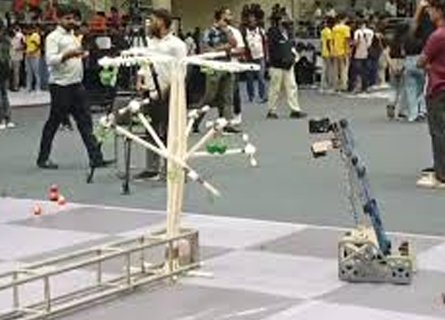
The AgriBot Challenge at Technoxian is a specialized robotics competition focused on the future of agricultural automation. Teams must design and build a custom robot — either manual or fully autonomous — capable of navigating a simulated farmland arena filled with obstacles and uneven surfaces.
The robot’s primary mission is to:
- Detect and identify artificial Red and Green apples
- Pluck apples from trees
- Sort and deposit them into the correctly matched collection containers
The competition evaluates technical excellence in object detection, actuation precision, real-time decision-making, and autonomous system design. Bonus points are awarded for 100% autonomous execution and successful full sorting of apples.
Learning Objectives
- Robotics Engineering
- AgriBot System Design
- Programming & Autonomous Navigation
- Problem Solving
- STEM Integration
- Teamwork & Collaboration
Who Can Apply?
Age Group
• Junior LEGO Category: 6–10 years
• Senior Category: 11–16 years
Team Composition
• Team Size: Minimum 3 – Maximum 7 participants
• Each team must officially declare: One Team Leader, One Operator
Robot Type
• The robot may be manually controlled via wireless remote
• Fully autonomous robots are highly encouraged and earn bonus points
Dimensions & Weight
• Maximum size: 45cm × 45cm × 45cm
• Maximum weight: 20 kg
Power Source
• Battery operated only
• Maximum limit: 15V and 5A
Customization Policy
• Commercial ready-made kits are prohibited
• The AgriBot must be a mandatory custom-built design
Junior LEGO Category (6–10 years)
For Juniors, “Kits” means LEGO Technic mechanical parts and LEGO Hub/Brain (EV3, SPIKE, or WeDo) for programming.
Senior Category (11–16 years)
For Seniors: open‑source platforms like Arduino, ESP32, sensors, etc.
Base Scoring
• 10 points for each successful apple pluck
• 10 points for correct container deposit
Performance Bonuses
• +20 points for sorting all apples correctly
• +20 points for 100% autonomous execution
Penalties
• Wrong container deposit: –5 points
• Dropping outside container: –3 points
• Tree damage or shaking: –10 points
• Holding more than two apples at once: –10 points
• Dropping apple into opponent’s container: –10 points
Duration
• Each match lasts 3 minutes (applies to Qualification & Finals)
Restarts
• Maximum one restart per round; allowed only for system failure or early movement
Timeouts
• Referees may call timeout for safety or technical reasons; all robot movement must immediately stop
Advancement
• Top-scoring teams from Qualification rounds advance to Finals
Referee – Manages gameplay, confirms scores, enforces all rules.
Assistant Referee – Tracks time logs, monitors rule violations.
Communication Rules – Only the Team Leader may communicate with the referee during the match.
Check-in – Teams must report 10 minutes before their scheduled match time.
Pre-Match Inspection – Time for robot inspection, calibration, arena briefing, and assigning team marker colors.
Starting the Match – Both teams raise a Green Card to signal readiness; referee begins countdown.
Apple Tree Zone – Central arena area where artificial trees are located.
Tree Height – Maximum 50 cm (Senior), 20 cm (Junior).
Container Zones – Two designated zones: Red Container (for Red apples) and Green Container (for Green apples).
Pathway – Includes obstacles and uneven surfaces simulating real farmland conditions.
Match Objectives – Navigate to Apple Tree Zone, detect and pluck apples, transport safely, deposit in correct container.
Qualification Round – All teams participate in multiple matches to accumulate points.
Finals Round – Top-scoring teams advance; number of finalists depends on total tournament participation.
Each team meets the judges to explain their design and programming approach.
Scoring Levels: Minimal – 1 point | Partial – 3 points | Mastery – 5 points
Evaluation Parameters
• Robot Design & Construction – structure quality, durability, optimization
• Programming & Autonomous Navigation – logic structure, response accuracy, control precision
• Strategy & Tactics – adaptability, strategic execution
• Teamwork & Collaboration – communication, coordination, role clarity
• Game Performance – consistency, execution accuracy
• Problem-Solving & Adaptability – handling unexpected challenges