Robo Hockey Challenge
19th-20th June, 2026
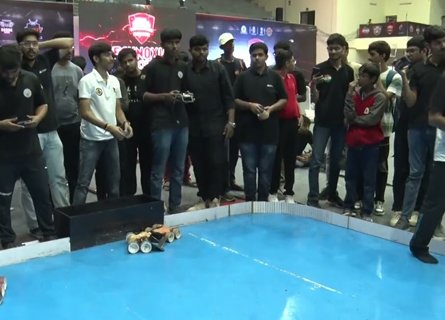
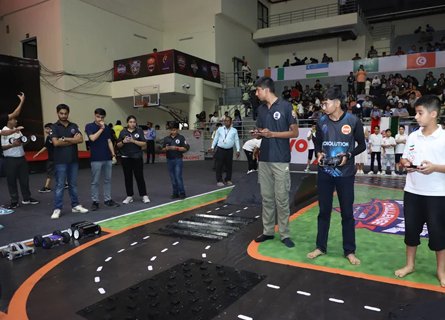
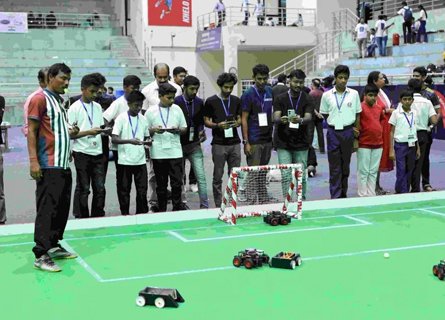
Robo Hockey 2026 – Robo Hockey is a fast-paced robotics competition inspired by ice and street hockey. The objective is simple: score more goals than the opposing team by pushing or shooting a standard weighted hockey puck into the opponent’s goal. To ensure dynamic gameplay and technical fairness, traditional hockey rules are modified and simplified to suit robotic competition standards.
Learning Objectives
- Robotics Engineering
- Strategic Thinking
- Programming & Control Systems
- Problem Solving
- STEM Integration
- Teamwork & Collaboration
Who Can Apply?
Age Categories
• Junior LEGO: 6–10 years
• Senior Open: 11–16 years
Team Composition
• Team Size: 3–10 participants
• Minimum: 3 members
• Maximum: 10 members
Dimensions
The robot must fit inside a 30cm × 30cm × 30cm cube.
Weight
Maximum weight: 7 kg (including batteries). 5% tolerance allowed.
Power Source
• Electric only (battery‑powered motors)
• Maximum battery voltage: 48V
Control System
• Wireless (Remote‑Controlled)
• Allowed frequencies: 2.4GHz, 900MHz, 75MHz
Interference Rule
Teams must not interfere with tournament Wi‑Fi or other teams’ radio signals. Violation may result in disqualification.
Mobility Requirement
The robot must be capable of multi‑directional movement (not limited to one axis).
A standard weighted hockey puck will be used.
Restrictions
• No Engulfing: Robots may not fully surround or trap the puck. A visible portion of the puck must remain visible from above at all times.
• Dribbling: Pushing and controlled pulling are allowed. Adhesives, suction, or magnetic holding are strictly prohibited.
• Kicking Mechanism: Mechanical kickers or flippers are permitted.
Two vs Two Match (Main Format)
• 2 robots per team
• Total match duration: 10 minutes (two halves of 5 minutes each)
• 1.5‑minute break between halves
• Continuous clock (except referee intervention)
Late Arrival Rule
Teams must report 5 minutes before match time. Late arrival may result in 1 goal penalty per minute. Failure to appear within 5 minutes = Forfeit (5–0 loss).
One vs One Match (Special Round)
• 1 robot per team
• Match duration: 2 minutes (no breaks, continuous clock)
Focus areas: Speed & agility, ball handling precision, offensive & defensive control.
Match Start
Robots begin on their respective sides. The umpire places the puck at center line. Movement begins only after official signal.
Continuous Play
After a goal: a new puck is placed immediately – no regrouping break.
Scoring
• Normal Goal: Puck must completely cross the goal line.
• Penalty Goal: If a team shoots the puck out of the arena (wild shooting), the opponent receives 1 automatic goal.
Legal Contact
Blocking and controlled impact are allowed. If a robot breaks due to a legal hit → no penalty.
Illegal Conduct
Attacking a disabled or flipped robot is prohibited; may result in removal for the rest of the round.
Sportsmanship
Unsportsmanlike behavior by players or coaches may lead to disqualification.
Tie-Breaker Rule
Robo Hockey matches cannot end in a draw. If tied after regulation time: Sudden Death applies. The next goal immediately determines the winner.
Dead Robot Rule
If all robots stop functioning:
• In Period 1 or 2 → Round ends early, standard repair break applies
• In Period 3 → Match ends immediately
• If tied & all robots are disabled → The robot that moved last is awarded the winning goal.
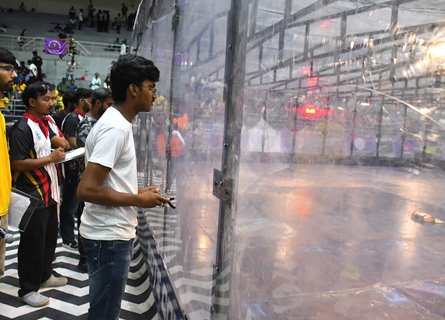
• Size: 24 ft × 12 ft rink
• 4 ft radius side curves
• Goal positioned 24” from rear wall
• Safety walls approx. 12 cm height
Robots must have enough clearance to maneuver behind goal areas (front access only).
Scoring Levels: Minimal – 1 point | Partial – 3 points | Mastery – 5 points
Evaluation Parameters
• Robot Design & Construction: structural strength, stability, game optimization
• Programming & Control: responsiveness, precision, stability under pressure
• Strategy & Tactics: offensive/defensive planning, adaptation
• Teamwork & Collaboration: communication clarity, coordinated play
• Game Performance: passing accuracy, shooting precision, defensive effectiveness
• Problem‑Solving & Adaptability: real‑time adjustments, tactical flexibility